


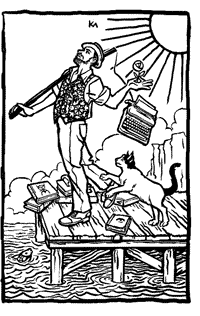

I hope we’re all ready to leave the phenomenal world, and enter into the sublime.
So here I am, at the edge of everything, ready to take a leap into moonbattery. Deep breath. Flex your knees. Roll your head this side to that, loosen your neck, free up your shoulders by swinging your arms back and forth. Spit in your palms and rub them together. Even though you’re not about to grab anything, it’s something to do, a sign and signifier of focussed intent. Step up to the edge. Grip it with your toes. Crouch a little, find your balance, careful. Easy. Feel that clutching tingle in your glutes. Savor the air, suddenly sharp in your nose. Your heart’s beating faster. Let it. Swallow. Okay: coil your muscles, arms back, ready to fling yourself over and out, take one more deep breath, hold it a moment, let half of it out, and—
There.
—Of course, I had to climb back up out of moonbattery to pose for that leap, and now I’ve made it, I’m not actually falling tumbling ass-over-tea-kettle into the outer darkness, shrieking oddly umlauted vowels, coughing up words with too many consonants: I’m maybe a foot away, still on the ground, hunkered over a little, dust puffing up from my feet where I landed. There was no edge. This isn’t moonbattery. It’s just a step or two away from where you are now. Maybe a little darker, but otherwise the same. We were warned, goddammit: it doesn’t take the pattern-skrying of a Teresa Nielsen Hayden or the fever-stoking of a Greg Palast to make it clear. We were told, up front. That nameless Bush aide cheerfully copped to it, in the Ron Suskind article linked ’round the world:
The aide said that guys like me were “in what we call the reality-based community,” which he defined as people who “believe that solutions emerge from your judicious study of discernible reality.” I nodded and murmured something about enlightenment principles and empiricism. He cut me off. “That’s not the way the world really works anymore,” he continued. “We’re an empire now, and when we act, we create our own reality. And while you’re studying that reality—judiciously, as you will—we’ll act again, creating other new realities, which you can study too, and that’s how things will sort out. We’re history’s actors . . . and you, all of you, will be left to just study what we do.”
Well, Bev Harris is studying what they did. You want a barricade? (Or a levee, to sandbag?) That’s as good a place as any to start setting one up.
The election was rigged. They stole it. Last time, they cold-cocked us when we both found ourselves in a suddenly dark room with nobody looking; this time, we went in with a flashlight, but they’d slipped us a mickey, and that’s why our lips are numb and our mouth tastes like cold pennies as we stand here, ready to make our little leap: the election was rigged. George W. Bush still isn’t president. (Except in all the ways that actually matter.)
And I’d like to say leaving is a crock, all due respect to my favorite popstar notwithstanding. I’ve said it, actually: leaving is a crock. There’s too much left to fight for and too much left to fight with for us to go gently into exile. But I’ve said it as much to buck myself up as anything else: I repeat it to myself, trying to spit that taste out of my mouth, to convince myself it’s true. Leaving is a crock, yes, but more to the point: leaving is hard. —But I’ve read “Jesus Plus Nothing.” They’ve told us up front what they want. They’ve cheerfully copped to it. We’ve been warned. And here I stand in Little Beirut, the capital of the People’s Republic of Multnomah County: somehow alienated, somewise cut off; alone, despairing, so very, very sorry.
Leaving is hard. But is it really harder than fighting?
What comes next? I don’t know. Whither the left? Ha! I barely can tell you what I’ll be doing tomorrow, beyond following Bruce Baugh’s sage advice the best I can, and keeping a weather-eye out for galiel’s canaries to start dropping. But can I just for a minute jump on the “moral values”-bashing bandwagon? We don’t need to start preaching, and we don’t need preachers (though we need everyone we can get). We know our morals and we know what we stand for and we know we’re right. What we need here on the left side, the side of progress, the side that gets things done, the somewhat more purple side that keeps picking those somewhat more magenta states out of the gutter and loaning them a sawbuck till payday that we know we’ll never see again, what we need is, and bear with me on this, we need a Daddy. We need father-figures to go on all the TV chat shows and sternly and implacably stick up for our values as we know them and lay down the law as we would write it with an ineffable air of authority that reaches right past the frontal lobes and plugs into the monkey-brain, there to patiently bit-by-bit unwire the awful “moral values” meme bombs with Truth and Justice and the American fucking Way, and I realize this is the voters-are-rubes argument, which is seemingly at odds with the voters-was-robbed argument, and I’ve plumped for the voters-is-mean argument, too, and probably will again, but elections are legion; they contain multitudes, and I know this is about to decohere into gassy rhetoric, babble and fury, but hear me out: what we need now is Atticus Finch, ladies and gentlemen.
So, hey, let me end with a quote from Barry Goldwater, that seems to have fallen off Will Shetterly’s site:
Now, those who seek absolute power, even though they seek it to do what they regard as good, are simply demanding the right to enforce their own version of heaven on earth, and let me remind you they are the very ones who always create the most hellish tyranny.
Using their own words against them! That’ll show ’em!

Commenting is closed for this article.

Testify, brother.
Pardon the metaphor, but we I think we do need preachers -- purveyors of the golden gospel of truth shouting it from the mountaintops. but we need to find a way to do it that will be heard and stick in the brains of the people.
The truth will set us free. If we can just make people believe it.
Go forth, brothers and sisters, and make "finching" the word of the coming years. Speak truth to power. Lots and lots of truth.
The most terrifying thing by far about the Black Box Voting site is the note in their sidebar:
"Please excuse our temporary reconstruction:
This site went down recently when we posted sensitive information."
::gulp::
Ah, nothing escapes the web!
I do like the Goldwater quote. I pulled the post for several reasons. One was that it just didn't seem constructive. I haven't figured out what is constructive. The only part I'm sure of is that we've got to find ways to work with honest Republicans for honest elections. And I think the Electoral College is the issue that can unite us.
As for Kerry, he ran Gore's campaign, had Gore's results, and quit. I keep wishing the Democrats had run Dean. Or had run Edwards as #1 and Kerry as #2. Or too many things to list here. If it turns out that there were honest or dishonest reasons why Kerry wasn't credited with all of his votes, it's going to be hard for him to come back from conceding.
Indeed; which is why I'm much more sanguine about concession outrage now than I was Wednesday morning.
And I should have added one more to what I'm facetiously calling "galiel's canaries": everyone keep your eyes on blackboxvoting.org, and Bev Harris' health and welfare.
Also, a mea culpa: the rather potent graphic in the Left Coaster post linked above, when traced back, ends up here, with nary a word as to source(s). There's not nearly enough salt on the ground to knock me back from my leap, but you might want to keep it handy as you peruse the other links. As ever, caveat lector.
http://www.nielsenhayden.com/electroside/archives/2004_11.html#005714
(Kip Manley's pretty good too.)...
Agreed:
(1) The motive exists.
(2) The means exist.
(3) It's plausible.
However, to quote Carl Sagan, extraordinary claims require extraordinary evidence. And election rigging is an extraordinary claim. But the evidence we've seen so far is not extraordinary -- just strongly suggestive.
There are many plausible explanations for the exit poll / vote tally discrepancies having to do with Kerry supporters voting earlier, a higher evangelical population in counties using e-voting, etc.
Until we can satisfactorily falsify these other explanations, we should not claim the certainty of voter fraud. Instead, we should be good scientists: work hard to get all the evidence we can, and then judge it objectively with a level head and a cool eye.
The truth is, we do not have certainty, only suspicion. Suspicion warrants investigation, and investigating is what we should now do. Premature certainty hurts the cause.
Your caution's well-placed, Paul; all I can say in my defense is that, not being directly involved in the investigation, I have the luxury of a leap of faith. —Also, that the differences in exit polling (when comparing the accuracy of paper-trailed precincts with the startling discrepancies in e-voting precincts) aren't the only scraps of evidence that pushed me to jump.
And I think people need to come to terms with the idea, if maybe not follow me over the edge all at once. (Really, it's not that far. First step's barely noticeable.) I'm seeing too many people regard the evidence of fraud and disenfranchisement as further signs it's time to leave, when, for me, they're trumpet blasts to fight; flags of hope, for God's sake. There aren't more of "them" than there are of "us." To quote the invaluable Julia, who shrugs Sisypheanly: this isn't a mandate. It's a ceiling.
Yeah, I know. Hope isn't a plan. But hope will get you through times of no plans better than plans will get you through times of no hope.
"Their own words"? That's giving them too much credit. What Barry Goldwater stood for has nothing at all in common with what these folks stand for. Barry Goldwater was pro-choice, pro-drug-decriminalization, and pro-gay rights. He spent the last ten or so years of his life complaining about how the fundie nutcases had taken over his beloved party.
I'm not really in touch with current political reality, of course, being a liberal, but does Bush getting more votes in Florida counties than there are registered voters constitute a smoking gun?
Registered voters who actually voted, that is.
I really don't find claims of Republican crimes and deceptions to be "extraordinary." Indeed, I think: that there were attempts at fraud is certain, that they succeeded is highly probable, and that they affected the electoral vote-count is possible. Probably I've seen more or less the same arguments Kip has. But wouldn't the scale have had to have been pretty huge to call into question GWB's having won the popular vote? And, lacking a majority in the popular vote, and with both houses of Congress and the press trying to destroy him, would Kerry have been able to do anything at all? I'm less angry at his concession now than I was on Wednesday.
La lucha continua, I guess.
whistling past the graveyard wherein lie side-by-side Truth, Justice and The American Way
It really does begin to look like the election was rigged. As Teresa Nielsen Hayden puts it, I deeply resent the way this government makes me feel like a nutbar conspiracy theorist. Unlike Jamie Zawinski, I don't want to believe it, because the idea th...
Show me a chart of the precincts that vote pro-Kerry that shows that they had fewer voting machines and you'll get my blood boiling (as long as you can show me how you generated it, and where ou got your data). Tell me how some states still haven't signed on to paper trails for e-voting and I'll shake my head and agree that we have to work harder. Tell me again how Florida still hasn't unscrubbed its voter rolls of the phony felon list (after 4 years!), and I'll agree the Florida elections department is a racist disgrace. Show me a real stolen election and I'll take to the streets.
Show me that lame 9 panel cartoon (with no documentation as to how it was constructed or why they used those states, and with the states mislabeled as to which e-vote) or that scatter diagram showing that the panhandle in Florida registers Dem, votes Repub, and uses optiscans (the best voting machines around, with a solid paper trail, a very low failure and spoilage rate, and a tendency to have simple, easily readable ballot designs) or point out that Ohio and Florida (and propably most other states) use some weird and confusing tabulation methods on parts of their web sites (that aren't primarily intended to be read by neophyte partisan hacks), and tell me that that junk constitutes even weak evidence of election rigging, much less strong evidence, much less proof, and I may find it hard to resist the urge to commit acts of violence.
Accept that we lost by a fairly narrow margin (both in the popular vote and in the EC), figure out if there is anything significant we did wrong, figure out what we can do more of or do better, and then go out and do it.
One thing we can definitely do better is not fall into the trap of wasting our time shouting fraud at every shadow.
Sorry, this shit is driving me nuts, and it seems to have taken over most of the left blogosphere. I like what you say after you get done with the moonbattery much better.
Purple cartograms, on the other hand, I really like, so I'm sure half the blogosphere thinks that it is people like me that are the navel-gazing problem.
Given that you posted this way back last week, I guess it is unkind of me to unload on you now, when I doubt you are still in the moon bat camp. Please consider that blast directed at the many too many who are still flittering about in moon bat form.
No, Charles, I'm still moonbatty, if by moonbatty you mean I think the election would have turned out differently had the Republicans not engaged in activities which, whether or not many of them are a fixture in every election ever, went well beyond roughhousing into obstruction, tampering, and fraud. Do I regret putting a link to a post trumpeting that "lame 9-panel cartoon" in such a prominent place? Yeah, I do. But hey: that's hardly the only thing that's turned up, and rigging the vote count itself is hardly the only method under discussion in the other links posted above.
Do I think crying fraud and demanding our due will somehow make it all as if it never happened (and then we can have a parade)? Um, no. Had the vote turned out "properly," we'd still be in an awful, intractable place, with one hell of an ugly four years ahead of us. —But I do think "studying that reality" is a fine and necessary thing to do, hardly worth an explosion of frustrated violence, and I think more awareness of and agitation for real elections reform is a good, good thing, well worth our time and effort: an important part of figuring out what we can do more of or do better, and then going out and do it.
Certainly, it's one fuck of a lot more useful than trying to move to Canada.
I think you were the one who called it moon battery first, so you can define it however you damn well please. I took it to mean throwing in your lot with the 9 panelists, the dixiecrat scatter plotters, and the incoherent election web page readers.
It would be a hell of a lot easier to find the lists of serious flaws if they weren't swamped by tin foil hat lists that include a repetition of every bit of misunderstood or misleading crap that anyone has come up with. I think I listed some additional things I would like to see that would point to real injustice.
Like I said, point me toward serious flaws. The Palast article isn't bad. The persistent use of crappy machines in predominantly poor and minority precinct is a serious problem. One worth addressing. One worth giving more attention to than the other crap. One that gets lost in all the other crap. The Hayden post, on the other hand, isn't good. No there there. Moon bats flitting all about.
You know, quoting from the article that led to the
coinage of "reality-based" as a descriptor for anti-Republicans while stepping over the edge into moon battery is pretty funny. I'm hoping you noticed.
Sigh. Focus on the serious shit, don't waste time on people misreading election reporting web sites (okay, that was Julia, not so much you). The exit polls are not the serious shit. Dixiecrats in the panhandle are not the serious shit (unless you are forced to work as an illegal slave on their sugar and orange plantations - okay they are serious shit, but they don't constitute election fraud).
Actually, the thing that annoys me about the Palast article is that he is almost certainly wrong. Kerry almost certainly didn't win the vote in Ohio, even with the hung chads (Palast's numbers are not convincing). If Kerry were close to winning the election on that basis, he would ask for a recount. The Kerry campaign raised tens of millions of dollars specifically for that purpose. Like everyone else, they were prepared to fight the last election. In the end, they appear to have realized that this wasn't last election. I wish other people would too.
And the crappy machines and the voter intimidation are a serious problem even if they didn't quite cost Kerry the election. Fight them for the wrong they are, not for the hope of partisan advantage.
You say "[study] that reality," and I agree. I just think you're chasing moonshadows when you should be looking at the ground under the shadows.
And dammit, you've driven me back to drink.
To my mind, the fact that one side has a decided edge in cheating the system is serious shit; certainly, more serious than yet another round of how-do-we-chase-the-middle-ever-rightward. —Which, admittedly, is not nearly so loud this time out.
The moonbattery? Yes, it seems like it to say, hey, you cheated; things would be different if you hadn't broken the rules you broke. (Note: "better" is not operative in that statement; Kerry winning the electoral college and losing the popular vote is a special nightmare all its own.) But at the same time, it's hardly that far: it's undisputed that the Republicans engaged in dirty tricks that suppressed the vote—tricks that will land some of them in jail. (And now I'm thinking of the recent winning strategy in the prisoner's dilemma, where pawns sacrifice themselves for the betterment of the group, or at least the elites of that group.) Max Sawicky has some good points about the provenance of fraud and the silliness of conspiracy; Lawrence Lessig has some good points about the exit poll data, and where the irresponsibility might lie. But Lessig's final point strikes me as just the sort of calmth and reasonability that gets us rolled: studying that reality, while a new one's being made, altogether elsewhere. (Then again, abandoning calmth and reasonability gets us more yawmping heads: more heat, less light, and the nines are left in the dust.)
As for finding it funny? Maybe not so much funny, but the title does kinda hinge on the, shall we say, irony.
See, I really didn't want to believe that this election was possibly stolen. But the more I hear and read, the more I want a hand recount of all ballots. Not so much to prove that the results are wrong as to give me faith that everything was counted properly.
While we're at it.... Elections are entirely a government function. All software used should be owned by the government. This is not something that should ever be open to the private sector. All voters should vote using the same technology, just like everybody uses the same forms to pay taxes. All votes should be hand counted to confirm the result tabulated by software. Then, and only then, will I have faith that an election has been done as properly as possible.
Maybe I've grown somehow even more cynical, or more likely I'm just lazy, but isn't all this just re-arranging deck chairs on the Titanic? We have an electoral system designed to minimize participation from the masses, reformed only to install more illusion of participation... and we're looking for cheating? The Christian fundamentalists had it right thirty years ago... start local. Don't sweat the big stuff until it is time. We get the America we deserve.
Scott,
Exactly.
Kip,
I just posted this on DailyKos, where it will vanish from human memory in about 30 minutes. I thought you might find these articles interesting:
These two articles on Florida Dixiecrats and Exit poll discrepencies (both from Voting Technology Project at Caltech and MIT) are the best analysis of these fraud claims I have seen.
The Florida fraud paper looks at the counties by size and location, compares 1996, 2000, and 2004 election results, and does an analysis of the effect of changing to DRE voting machines. The effect of changing is particularly striking: none (regression slope of less than 0.01).
The exit poll paper looks at all 51 state polls (including DC), and finds that the final exit poll results had 30 states that overpredicted Kerry, and 21 that underpredicted Kerry. There were three outlier states, but they weren't the ones you think they were: New York, Oklahoma, and Rhode Island. All three had errors of worse than 5% (which kills the concept that the error in Florida in the uncorrected data was unthinkably huge), with 2 overpredicting Kerry, 1 overpredicting Bush. All three were non-swing states, and all three don't use DRE voting. The other 48 states showed no clear patterns.
The second paper also goes through the debunking of the silly nine-panel exit poll gragh popularized by bluelemur/raw data. In particular, it points out that the categortization fo states by equipment is completely wrong.
I welcome recounts in any and all states, as much to confirm that fraud didn't happen as to discover if it did. My only worry is that the proof of no fraud that the recounts will reveal will be used as arguments that everything is hunky-dorry. It isn't.
Thanks, Charles. (I’ve been wondering about comparisons with earlier votes in Florida. Seemed the obvious first step.) —But: given that one side depends on preventing as many votes as possible, conclusion no. 2 from the Florida paper keeps my moonbat wings in place, and needs to be repeated a lot:
Also, here’s a solid paper on the scope of the problem itself, from the eminently sensible Bruce Schneier.
And hey, at least some little good news: we did pretty okay, locally. So.
Why do I feel like I'm sitting on an old couch, surrounded by paper? It's an Ennead reunion...
Check out the page http://www.mutanteggplant.com/singleagent.htm
This hypothesizes a method by which a single agent can alter election results nationwide.
See particularly the reference to the AP NEP person attaching a laptop computer to a vote tally computer during the counting.